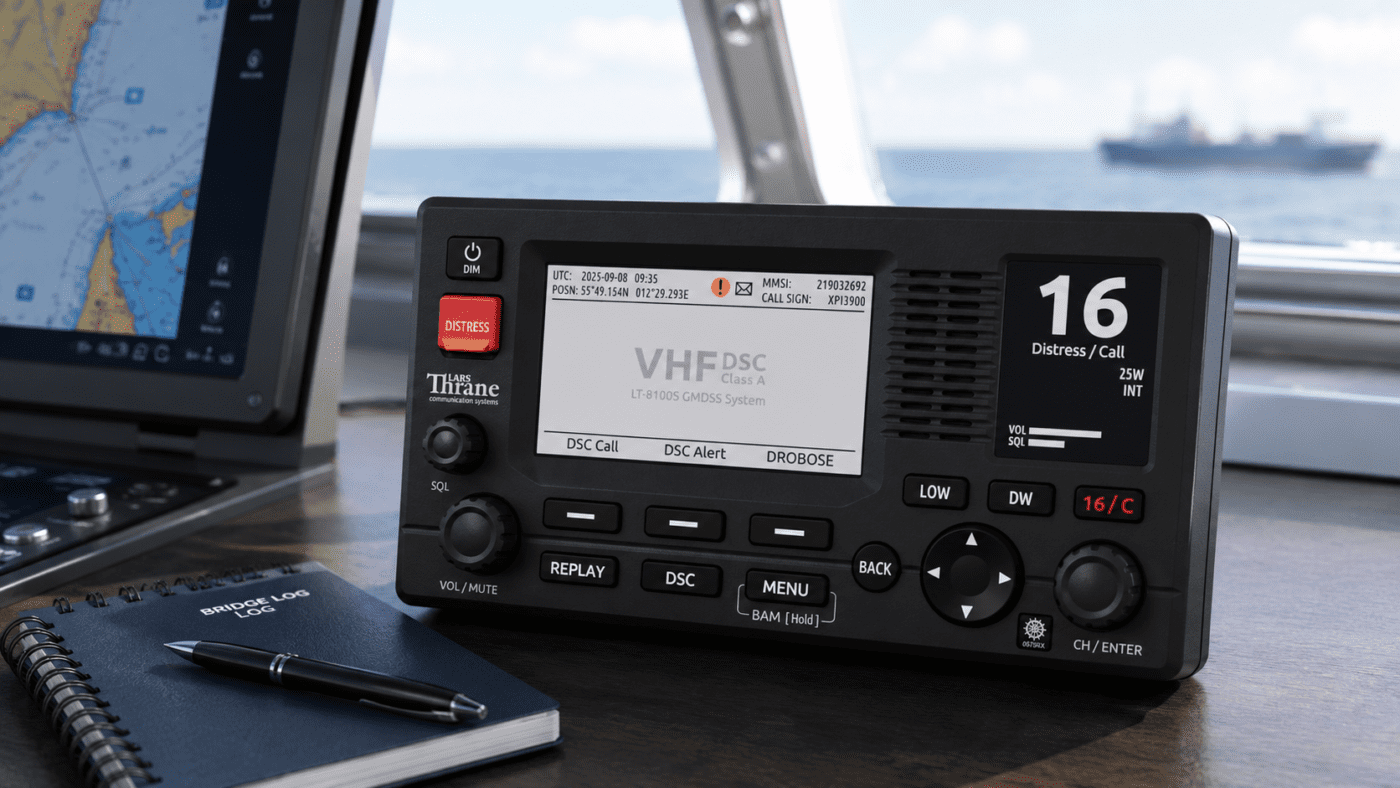
Built to the newest requirements
The LT-8100S supports all GMDSS VHF radio requirements for SOLAS vessels. It is Wheelmark approved and fully compliant and tested towards the newest SOLAS and IMO type approval, carriage, and performance requirements — alongside Maritime CE, FCC, ISED, RED, and RoHS 2 certification.For owners and yards, that has a practical meaning: this is not an existing design patched up to meet today's rules. The LT-8100S was developed against the current requirements from the start.
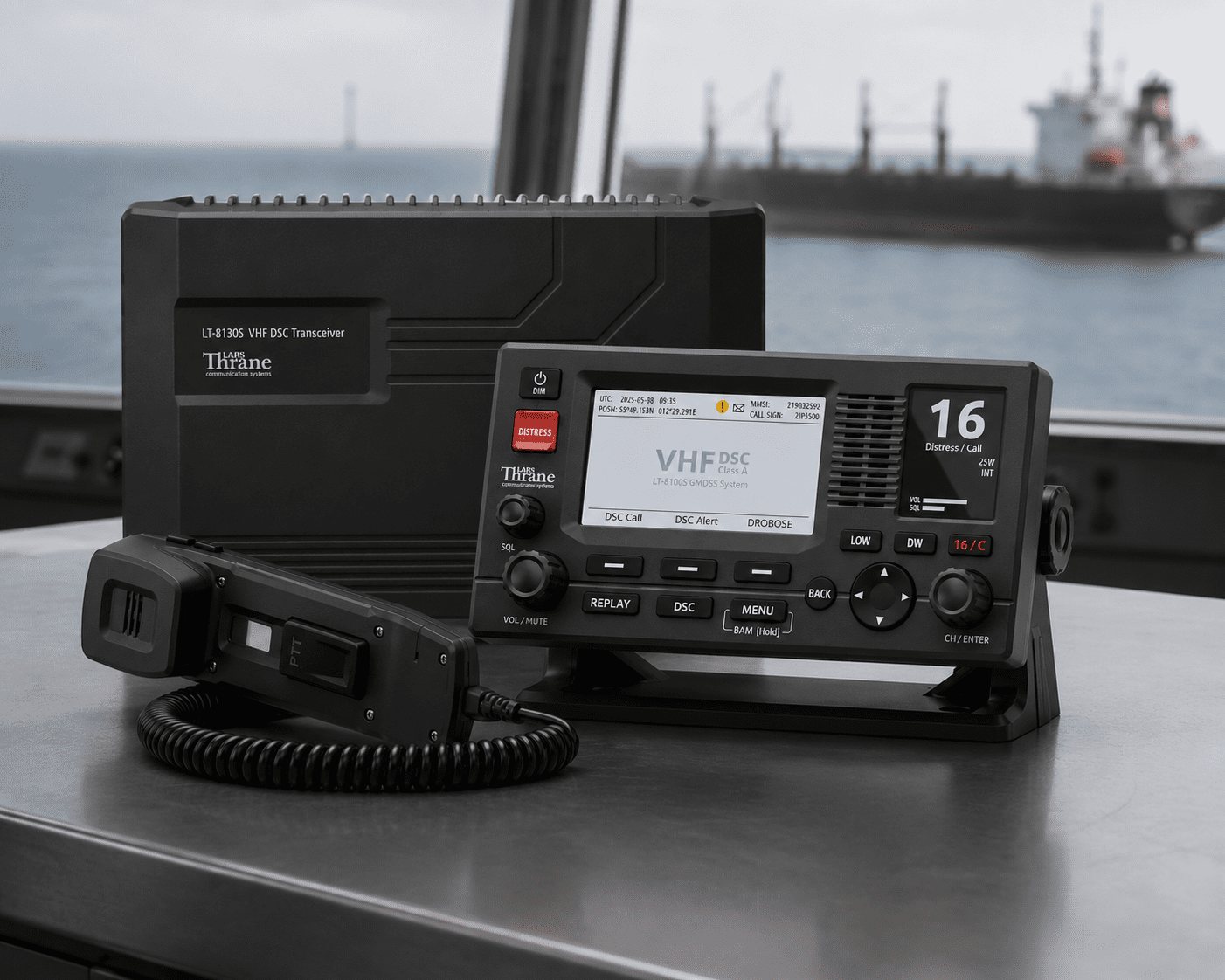
A clean two-box installation
Anyone who has wired a GMDSS console knows where the complexity usually hides: in the boxes between the boxes. The LT-8100S removes them.The radio is a two-box solution — a control unit at the operating position and a transceiver unit that powers the entire system and carries all internal and external wiring. No extra interconnection boxes are required. A single connection cable links the two units with up to 50 metres of separation, so the transceiver can be installed where it makes sense for the vessel, not where the wiring dictates.And the system grows with the installation. Up to four additional Handset PTTs, Remote Controls, or Control Units connect directly via the transceiver unit, which also carries the interfaces a SOLAS bridge expects: Bridge Alert Management (BAM) and position input over RS-422, VDR and speaker outputs, a discrete alarm input, and four AUX ports for additional equipment.
Two displays, push buttons, no hunting
In daily use, the LT-8100S is defined by a deliberate design choice: a two-display layout. The radio display always shows the channel number and its related information — large, unambiguous, permanently visible. The general display handles DSC functionality, settings, and detail. The result is a radio where the essentials never disappear behind a menu.Equally deliberate: the interface is push-button, not touch. A safety radio has to work with wet hands, gloves, and in heavy weather — exactly the conditions where touchscreens struggle. Physical buttons, clearly laid out, are the right tool for the job.DSC itself is implemented to stay manageable under pressure. A dedicated DISTRESS button — pressed for a deliberate three seconds — broadcasts a Distress Alert on channel 16 at 25W. The radio handles up to seven simultaneous DSC sessions, with the active session clearly marked, so a busy safety picture stays readable.
The details that make living with it easy
The rest of the LT-8100S reflects the same engineering habits found across the Lars Thrane range. Configuration and service run from a PC Service Tool over USB-C, connected at either the control unit or the transceiver unit. Dual antenna connections serve the voice and DSC receivers. The system draws modest power — 15W at idle — from a 24 VDC supply. And as with every Lars Thrane product: no scheduled maintenance, and a two-year warranty.In the box: the LT-8110S Control Unit, LT-8120 Handset PTT with cradle, LT-8130S Transceiver Unit, bracket mount, connection cable, and manual. Antennas — available in 3dB and 6dB versions with matching mast mounts — power cable, and coaxial cables are ordered separately to suit the installation.